News &
Events
The Shearwater Racing Catamaran: Seven Decades of Composite Evolution
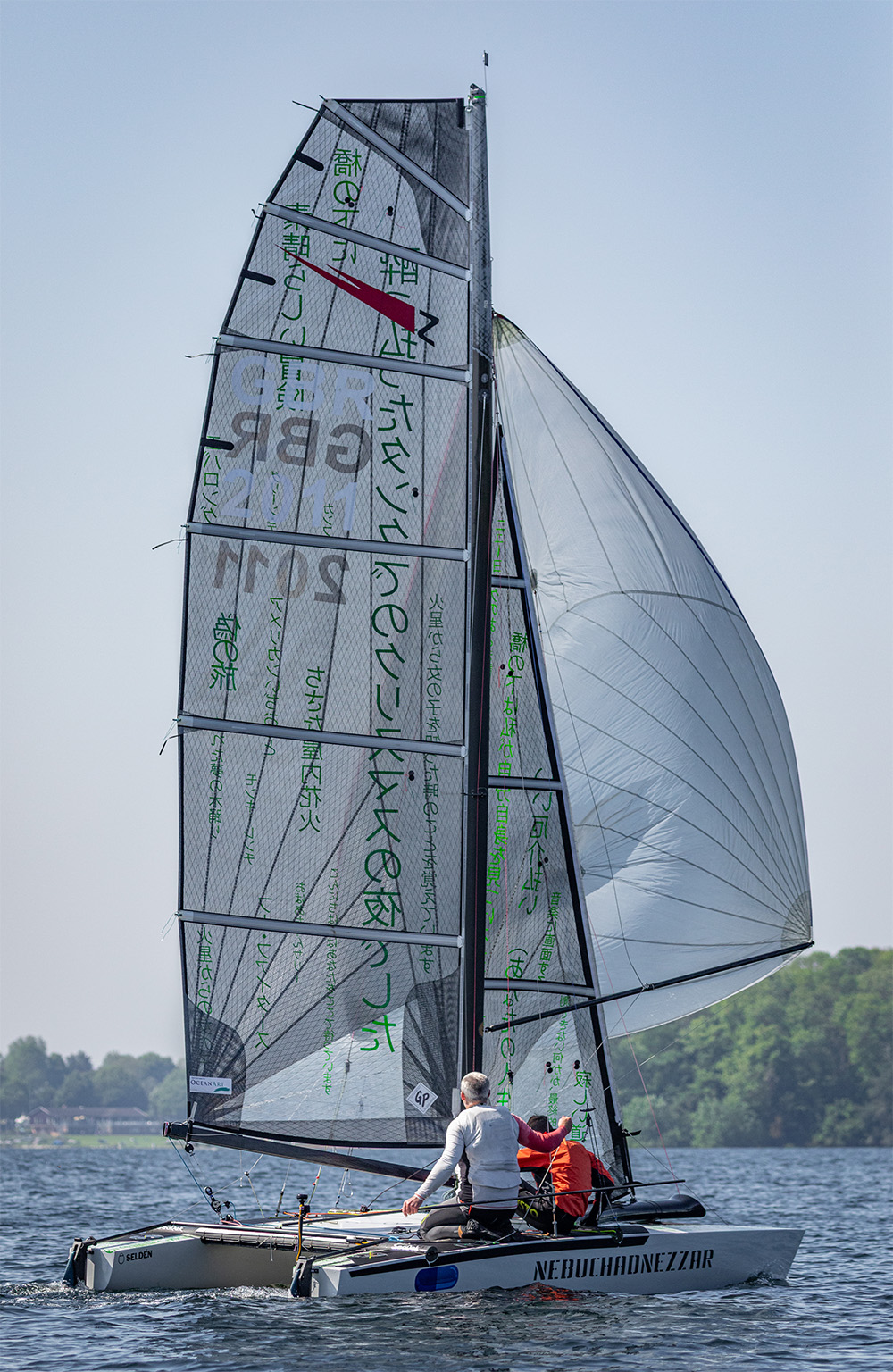
The Shearwater catamaran is one of the UK’s most enduring and technically progressive multihull classes. First designed in 1956, the Shearwater celebrates its 70th year as a class, from cold-molded timber to today’s full carbon, foam-cored epoxy structures.
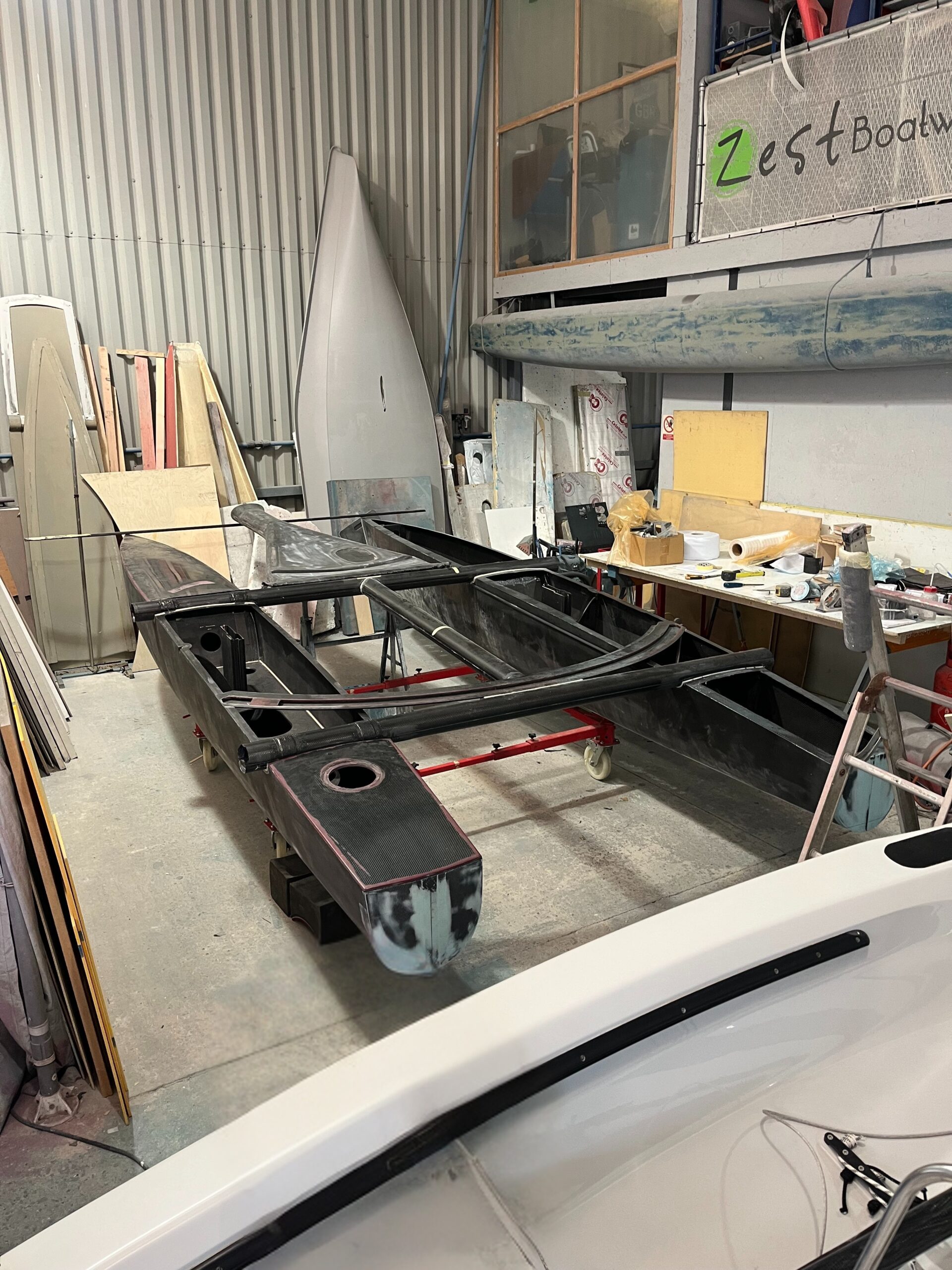
That evolution continues with the latest Shearwater racing catamaran built by Zest Boatworks, under the direction of owner and boatbuilder Pete Jary. Built using advanced composite materials from Gurit, the boat represents the cutting edge of Shearwater design while remaining firmly rooted in the class’s rich heritage.
The unfinished boat will be on display at the RYA Dinghy and Watersports Show 2026 on 21-22 February, offering a rare opportunity to see the structure and materials behind a modern high-performance racing catamaran.
The Evolution of the Shearwater Design
The original Shearwater 1, launched in the mid-1950s, was conceived as a lightweight, fast catamaran built using the materials and methods of its era. Early boats featured cold-molded laminated timber hulls and timber crossbeams, pushing performance boundaries at a time when multihulls were still a rarity on UK waters.
As the class developed, Shearwater 2 and 3 designs refined hull shapes, beam geometry and rig layouts, steadily improving speed and handling. Crucially, because the Shearwater is a restricted development class rather than a strict one-design, designers and builders were free to innovate, allowing the class to evolve.
Over the following decades, plywood and timber gave way to composite construction and structural efficiency steadily increased. Today’s Shearwaters are the result of this continuous refinement, and the latest in development from Zest Boatworks is a full carbon, foam-cored racing vessel designed to deliver exceptional stiffness-to-weight ratios while remaining unmistakably Shearwater in character.
Further details on the class history and development can be found via the Shearwater Catamaran Class Association.

Zest Boatworks & Gurit
In a racing class where structural efficiency and durability are paramount, material choice plays a crucial role. Over more than two decades, Pete Jary has put his faith, skill and approach to construction and repair in Gurit materials and solutions.
This long-standing relationship is built on the trust and knowledge that Gurit’s materials will perform as expected, that processing will be consistent and that the finished structure will stand up to the demands of competitive racing.
“I have been using SP/Gurit materials for over 25 years building and fixing many lightweight racing dinghies. Ampreg resins have always been my go-to for new or repair laminates, as I can reliably build or rebuild the structure and also carry out gelcoat repairs on it. For bonding operations, Spabond is an easy-to-use, dependable adhesive. When it comes to core, my only core of choice is Corecell M foam.”
Gurit Materials in the Latest Shearwater
The newest Shearwater racing catamaran from Zest Boatworks is a fully composite and epoxy structure that represents the latest chapter in the class’s evolution. Gurit materials play a central role in achieving the performance, durability and build quality required.
The combination of these materials enable a lightweight yet robust structure that reflects how far the Shearwater has progressed since its timber origins.
- Ampreg Epoxy Resin Systems – selected for their excellent mechanical performance, predictable processing and versatility for both new construction and repairs.
- Spabond Structural Adhesives – providing reliable, easy-to-use bonding for critical structural joints throughout the boat.
- Corecell M Foam Core – delivering outstanding toughness, damage tolerance and weight efficiency.
RYA Dinghy and Watersports Show 2026
From Shearwater 1 through to today’s composite designs, the class has remained a living example of how thoughtful rules and passionate builders can drive decades of meaningful innovation. The latest boat from Zest Boatworks demonstrates how modern materials and techniques can be applied without losing sight of the class’s heritage.
Visitors to the UK Dinghy Exhibition on February 21–22 will be able to see this legacy first-hand, with the unfinished Shearwater from Zest Boatworks offering a unique insight into the structure, materials and craftsmanship behind one of the UK’s most enduring racing catamarans.
Contact us
For more information on the Gurit materials used in this project, or to discuss how our composite solutions can support your own application, please contact the Gurit team.